
Automate your onboarding now & join 1500+ agencies using Leadsie.
14 day unlimited free trial
Extend until you onboard a client
No credit card required
Keep access to clients if you cancel


Automate your onboarding now & join 1000+ agencies using Leadsie.
Approved by Meta, Google & Tiktok
Keep access to accounts if you cancel
Secure & 100% GDPR compliant


Landing another client should be good news… yet agency growth has a way of turning yesterday's perfectly workable process into tomorrow's source of missed deadlines. The founder who once knew every account can't review every campaign forever. A specialist who managed a handful of advertisers may suddenly spend more time on calls than on their ads.
The problems rarely arrive together, and they don't all begin at 50 clients.
Some agencies feel the strain much earlier, depending on the kind of work they sell and what they promise each account. We wanted to understand which processes tend to give way first, so we looked at recent industry research and asked people running paid-media agencies what had actually gone wrong as they grew. Their answers were much more specific than the usual advice to “build better systems.”
Winning more clients is exciting, until the processes that worked perfectly well for ten accounts start falling apart at thirty. Suddenly, people are chasing updates, information lives in five different places and small mistakes take longer to catch. Chances are, those problems existed before. There were simply fewer opportunities for them to cause trouble.
Some of the frustrations agency owners talk about are surprisingly common.
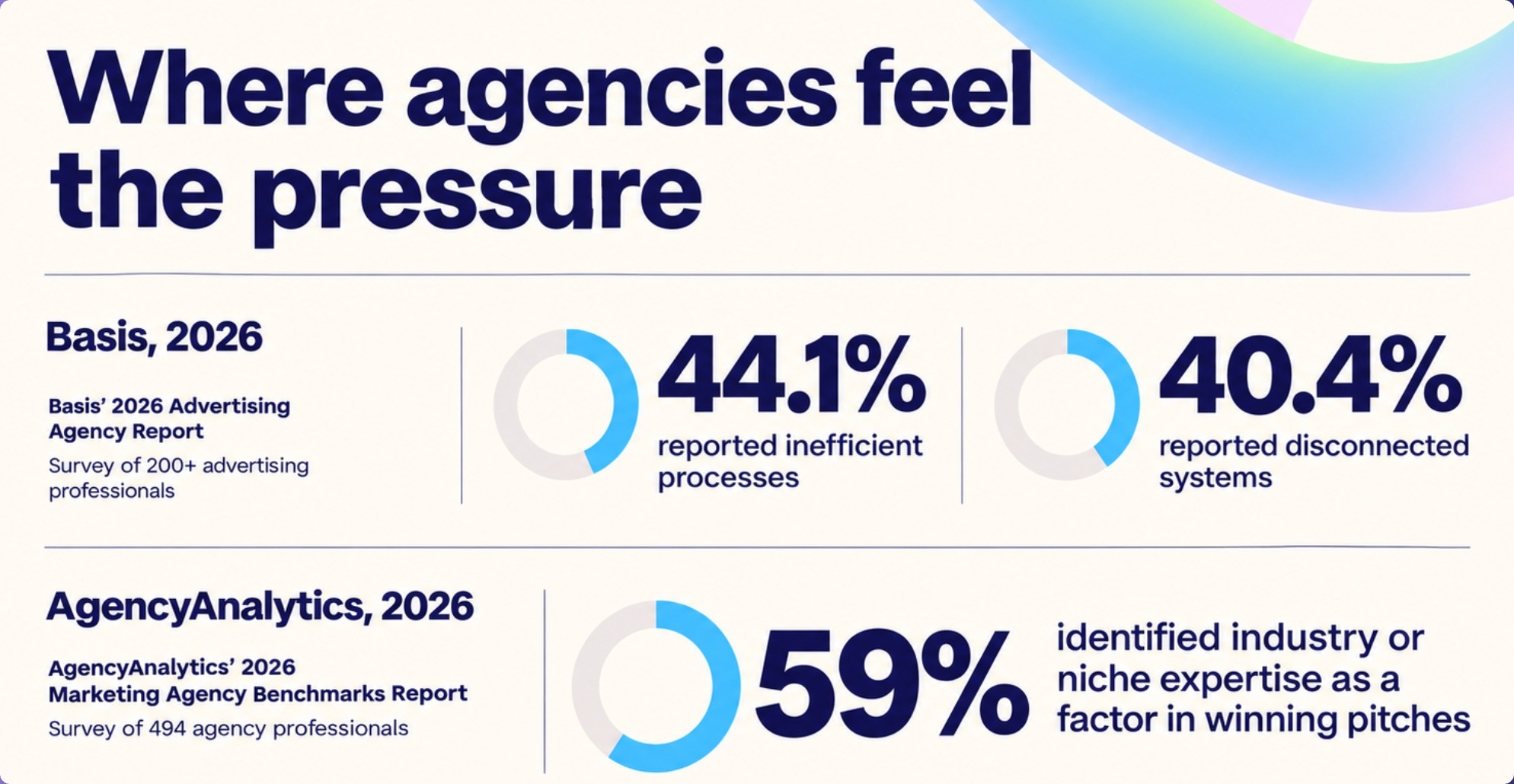
According to Basis' 2026 Advertising Agency Report, 44.1% of surveyed advertising professionals pointed to inefficient processes as an operational challenge, while 40.4% reported problems with disconnected systems. More than 200 professionals took part in the research.
Naturally, those numbers aren't specific to agencies growing from 10 to 50 clients, but the problems themselves are oddly familiar. A process can be inefficient for months before anyone questions it, especially when the team is small enough to work around its shortcomings.
There's an interesting tension here, too. AgencyAnalytics' 2026 Marketing Agency Benchmarks Report, based on 494 agency-professional responses, found that industry or niche expertise was the most frequently selected factor in winning pitches, at 59%. Clear reporting also featured among the reasons agencies win work. Clients expect specialist knowledge and want to understand what their investment is producing. Keeping up with those expectations gets harder when the same people are responsible for increasingly large portfolios.
The figures help explain why agency operations deserve as much attention as new business. They don't tell us which process will break first in any particular agency. For that, we asked PPC agency founders and delivery leaders to describe a real failure, how they noticed it and what they changed. We also looked at first-hand discussions in PPC communities, where the disagreement over account workloads is especially revealing.
At 10 clients, a founder can reasonably know which campaign is under review and why a particular client is unhappy with their leads. That knowledge can make a small agency feel unusually responsive. As the team expands, though, the same habit makes decisions dependent on someone's availability.
John Karsant, founder and CEO of LevelUp Leads, described exactly that transition. His most acute experience came later, while the agency grew from roughly 50 clients toward 100, but the underlying problem will be familiar to smaller teams:
“I think our founder-centric approach was the first thing to break down as we scaled.”
“When we had about 10 to 15 clients, it was easy to speak to them and give them manual updates on their campaign. I could walk them through our progress and explain what we were doing and why. But then we started growing from 50 clients to 100, and I immediately felt like I was stretched too thin. I couldn't stay on top of every campaign."
Karsant brought in an operations leader to handle day-to-day delivery and introduced a client-facing dashboard so clients could follow campaign updates without relying on a personal explanation from the founder. It's worth distinguishing those fixes: one changed who made operational decisions, while the other reduced the need for routine updates to pass through the same person.
Review one recent week of account work, including tasks that appear to be assigned but still require founder approval. Give a delivery lead authority over routine decisions within agreed limits. Keep a clear escalation route for unusual risks, such as a major budget change. A growing agency needs the founder's judgment available where it makes a difference, without making the founder the default step in every workflow.
There isn't a reliable universal answer to “How many PPC clients can one person handle?”. Ask 10 agency owners and you'll probably get 10 different numbers. Some might comfortably manage 15 accounts, while others struggle with five. A lot depends on the complexity of those accounts, what clients expect and how much work happens outside the ad platforms themselves.
That came through clearly in a discussion on r/PPC. u/Plastic-Cress-2422 described managing roughly 20 Google, Bing and Meta accounts and struggling to find enough time for strategic work. Another practitioner, u/wafflestation, responded:
“20 accounts is insane.”
That commenter described finding even nine accounts demanding. u/PreSonusAmp offered a more qualified take:
“Complexity and client matter.”
Both reactions can be true in different working environments.
Twenty smaller accounts in the same vertical, with defined service levels and shared reporting, may look very different from nine larger advertisers whose campaign structures change every week. The number of accounts is a poor capacity metric when the accounts themselves aren't comparable.
That's why you should measure the workload people actually carry.
Rather than assigning every specialist a fixed number of clients, look at what each account requires. A stable Google Ads account with monthly reporting is very different from one testing new offers every week.
A quick workload review can help:
Repeat the review as new clients come in. What worked with 10 accounts may need adjusting at 15.
More clients don't necessarily create a better business if each new account requires a completely different way of working.
Mariia Grachova, CEO and co-founder of Loona Agency, said her agency initially accepted work across unrelated industries:
“The first thing that broke for us was how we chose clients. In our first year at Loona I believed more clients meant more money, so we said yes to almost any business that came in. Every client from a new industry meant learning a market from scratch: its seasonality, its deal cycle, the objections its customers raise.
Very little of what we learned on one account carried over to the next, so each new client made delivery slower and harder to plan.”
Loona eventually concentrated on US construction and home services, where the team could carry lessons from one client to another. Grachova also changed the first sales call to discuss the prospect's margin and acceptable customer-acquisition cost. Those questions gave the team a commercial target before it started building campaigns.
Price and scope an unfamiliar sector according to the extra discovery work it requires. If a prospective client sits outside the team's usual niche, ask the person who will lead delivery what they need to learn before making the first credible recommendation. Specialization isn't mandatory, but pretending every client takes the same effort can quietly destroy a retainer's margin.
A reporting commitment that works for five clients can consume a remarkable amount of capacity at 20, especially when the person compiling the report is also responsible for improving the campaigns.
In an r/agency discussion about client reporting, u/DanielsLoud described a paid-traffic setup with one marketer and one account manager covering roughly 10–20 clients. Each client had a 30-minute weekly call and the team spent about 20 minutes preparing the report beforehand.
At 20 clients, that schedule implies 10 hours of calls and 6 hours 40 minutes of reporting preparation every week across the pod. That's 16 hours 40 minutes before follow-up emails, unexpected client questions or the actual PPC work. This is a calculation using one Reddit user's described schedule, not an agency-industry average.
Another participant, u/ggildner, questioned the frequency:
“My instinct is that you may be over-reporting.”
The suggestion was to rely more on accessible dashboards and use reporting conversations when they have something meaningful to resolve. John Karsant's experience with a live client dashboard points in a similar direction, although a dashboard cannot replace an account manager's judgment when performance needs explaining.
Start by reviewing what clients receive each month and how much of it they actually use. Then adjust your reporting cadence accordingly:
Removing the founder from everyday decisions creates another challenge: who is allowed to approve work that could affect campaign performance?
Ivan Vislavskiy, CEO and co-founder of Comrade Digital Marketing, said he had become the quality gatekeeper for nearly everything. Work queued up waiting for his sign-off, even when the team was capable of completing it.
“What I did differently was to stop being the one who decides if something is good or bad and put a system in place. We outlined what "good" looks like in our routine work, so quality does not depend on me;
I transferred the actual authority to approve the work to qualified staff, rather than passing everything through me.”
That solves one side of the problem; the other is deciding where a change genuinely needs more scrutiny. A routine bid adjustment is unlikely to need the same approval path as a change to conversion tracking or a live landing-page experiment.
John Mac, who’s as Head of Delivery & Strategy at Yikes! Australia, shared a more tangible failure. Team members could edit landing pages with visual builders while paid campaigns were live. Sometimes ads led to broken pages. More subtly, pages changed while A/B tests were running, leaving the team with results it couldn't confidently interpret.
“When we were running A/B tests, we found that pages were being edited, thus invalidating our test.”
According to Mac, the agency restricted page edits to developers and asked others to submit requests through tickets. Changes could then be scheduled with the experiment in mind. The fix was narrow, but it protected a point where an innocent-looking website update could waste advertising budget.
Write approval rules around the changes that create financial or measurement risk. Document who can authorize them and what needs to be checked before work goes live. Our article on common client onboarding mistakes is also relevant when approval responsibilities need to be agreed with clients at the start of a relationship!
One of the least obvious problems in a growing agency is the gap between agreeing to a request and doing the work the client expected.
Vaibhav Kakkar, founder and group CEO of Digital Web Solutions, described an informal intake process that initially worked through messages and conversations. With more clients, the team discovered differences between what people had asked for and what had actually been completed.
“We identified the problem by comparing requested tasks with completed work. The gap came not from a lack of effort but from unclear requests and shifting expectations. We introduced one intake process that required a business reason, an owner, a deadline, and approval.”
That structure is extremely relevant when a client asks to change campaign targeting. Recording the instruction alone may miss why they wanted it changed. The media buyer should be able to see the intended outcome and whether the request has been approved before altering a live campaign.
Jimi Patel, director of eStore Factory, encountered a related problem in Amazon advertising. Around 20 active accounts, information about clients lived with the senior people who had originally sold the work. One stalled Brand Registry case led to three different explanations from three colleagues.
“What we changed: every account now has one documented owner and a written account brief that lives outside anyone's memory.”
An Amazon Brand Registry issue and a Google Ads campaign request are two very different things, but the lesson for agencies is much the same: someone else should be able to pick up an account without spending hours piecing together its history.
A good handover doesn't need to document every conversation. It should give the next person enough context to understand the client's priorities, what's already been agreed and what still needs attention.
The same goes for incoming requests. Once a call or conversation ends, there should be a clear record of what the client asked for, who's responsible and what happens next. If the only person who knows the status of a request is the one who first received it, something's missing from the process.
Every new paid-media client brings extra work before the team can even start making campaign decisions. The agency needs access to the right ad accounts, often along with analytics permissions, before anyone can properly review past performance.
The deal might already be marked as won, but the media buyer is still waiting for access. The account manager sends instructions, the client forwards them to someone with admin rights and the initial audit gets pushed back another day. It's easy to dismiss these delays as one-off frustrations, even when the same thing happens with almost every new client.
As the agency grows, those small delays add up. A few things can make the process easier:
Client onboarding tools can take some of the manual work off your team's plate, too. Leadsie, for example, lets agencies request access to supported marketing accounts through a shareable link, so clients don't have to follow a different set of instructions for every platform. Your team still needs to verify the permissions, but there's less back-and-forth just to get started.
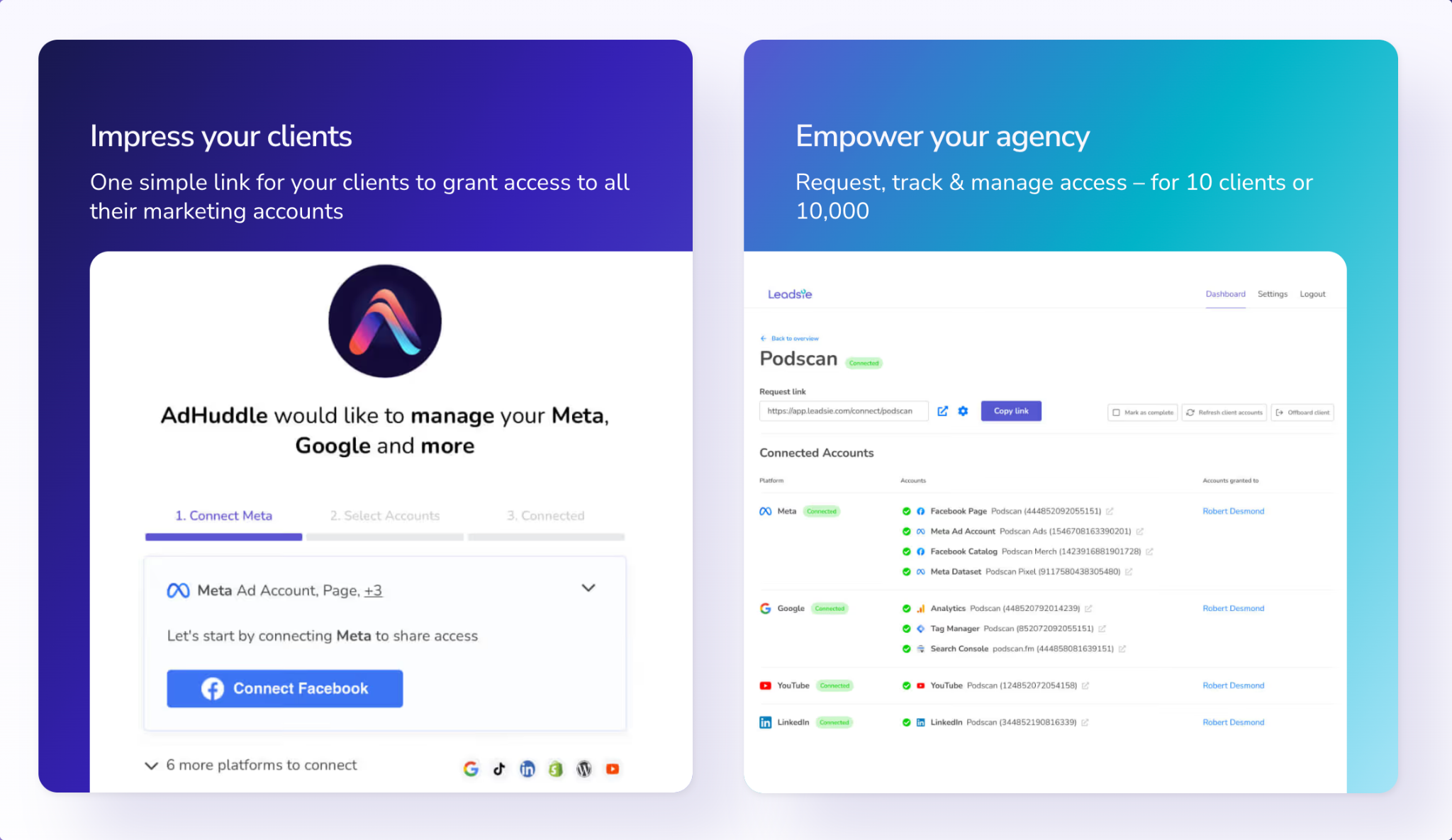
If onboarding is becoming a regular bottleneck, our seven-step agency onboarding guide covers the wider process. There's also a guide to automating agency client onboarding if you're looking for tasks your team can stop repeating manually!
If your agency signed 10 new clients tomorrow, what would break first?
Would your founder suddenly have another 10 accounts to oversee? Would your media buyers spend more time on calls than optimizing campaigns? Or would half the new clients still be waiting for onboarding to finish two weeks after signing?
The agency owners we spoke to had different experiences, but their stories point to something worth paying attention to. Growth tends to expose the processes that were already causing frustration when the team was smaller. The difference is that, with fewer clients, someone usually had enough time to work around them.
So, before chasing your next 10 retainers, take a closer look at your last five.
How long did it take to get each account up and running? Where did people get stuck? Which tasks needed chasing, and which decisions ended up on the founder's desk?
You might discover that you need another media buyer. But, you might also find that your existing team could handle more clients with fewer unnecessary meetings, clearer responsibilities or a better onboarding process.
And some improvements are easier to make than others! Getting access to a client's advertising accounts shouldn't require days of emails and follow-ups. Leadsie can take much of that back-and-forth out of the equation, giving your team one less thing to chase when a new client signs.
Try Leadsie free for 14 days - No credit card needed and no strings attached.
The next 10 clients should be an opportunity to grow your agency, not a reason for everyone to start working longer hours. Fix what keeps slowing your team down now… while you still have the room to do something about it.
Still sending onboarding emails, sharing PDFs, or jumping on calls just to get access to a client's accounts?
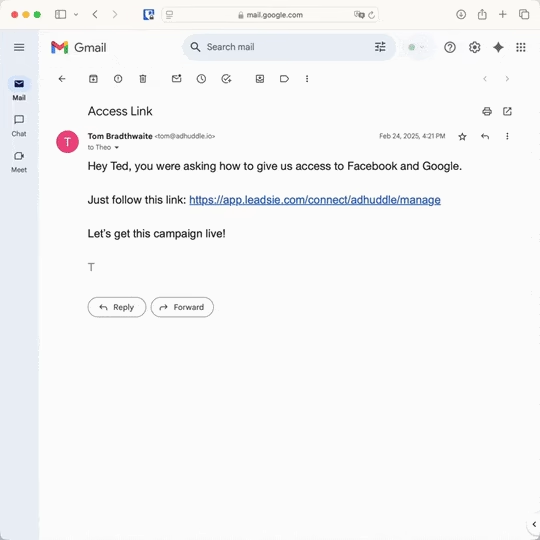
With Leadsie, one secure link handles the entire process. Clients can grant access to Meta, Google, LinkedIn, TikTok, Shopify, and 14+ marketing, advertising, and social media accounts without sharing passwords.
✅ Get access to client accounts in minutes, not days
✅ Replace hours of emails, admin work, and onboarding calls
✅ Scale client onboarding without adding operational overhead
✅ Reduce your agency's turnaround time by over 50%
✅ Start billable work and billing cycles sooner
✅ Create a professional onboarding experience that helps retain clients
✅ Keep access secure with 100% GDPR and CCPA-compliant workflows
💬 "I never want to do onboarding without Leadsie!" - Alyssa, Meta Ads Manager
🎁 Start your free 14-day trial today —no credit card required.
P.S. It's risk-free, and you get to keep your account connections after the trial ends. 🙌

Kinga Edwards has spent the last 15 years working in marketing agencies, and somehow… still loves the industry. She runs Brainy Bees, where she helps B2B companies grow through content, SEO and all sorts of marketing experiments. She’s a big fan of trying new things, has more side projects than she probably needs and rarely runs out of ideas. When she’s not working, she’s usually somewhere around the world or planning where to go next!


Automate your onboarding now & join 1500+ agencies using Leadsie.
14 day unlimited trial
Extend until you onboard a client
No credit card required
Keep access to accounts if you cancel
Approved by Meta, Google & TikTok
Secure & 100% GDPR compliant
Automate your onboarding now & join 1000+ agencies using Leadsie.
Approved by Meta, Google & Tiktok
Keep access to accounts if you cancel
Secure & 100% GDPR compliant
Questions unanswered? Check out our help center or get in touch 🤠


