Clients struggling to share access to their
accounts? Get the access you need in minutes with a free trial of Leadsie.
14 day unlimited free trial
Extend until you onboard a client
No credit card required
Keep access to clients if you cancel


With easy one-link access requests for 13+ platforms your campaigns can go live in minutes, not days. Start free today.
Approved by Meta, Google & Tiktok
Keep access to clients' accounts if you cancel
Secure & 100% GDPR compliant


To get access to a client's Facebook ad account without sharing passwords, there are two native methods depending on whether your client has a Meta Business Portfolio:
For most agencies, Advertiser access is sufficient to create and manage campaigns.
There are two native ways to request access to your client's Facebook ad accounts, plus a third option for clients without a Business Portfolio:
1) Partner Access (via Meta Business Suite): best for agencies who need access to multiple assets and want to assign permissions to their whole team.
2) Request by Ad Account ID (via Meta Business Suite): best when you only need access to a single ad account and already have the client's Ad Account ID.
3) Direct add via Ads Manager: for clients who don't have a Meta Business Portfolio. They add you by email directly in Ads Manager settings.
💡 Pro tip: Need a faster method? Leadsie automates the entire process with a single shareable link. No Business IDs, no manual steps.
🔗 Related: How to create a Facebook Ad account
If you prefer a video, here’s how to get access to a Meta Ad Account & Facebook Page:
There are three ad account roles:
For most agencies, Advertiser access is sufficient. Avoid granting Admin unless billing or user management is part of the scope.
Before you start, the right method to use depends on your client's setup:
Does your client have a Meta Business Portfolio?
Not sure? Ask your client to check business.facebook.com. If they can log in and see a Business Portfolio, they have one.
Requesting partner access through a business portfolio is the usual method for agencies, freelancers, and marketers as it allows you to assign permissions to your own team (instead of having your client give access to 4 of your teammates individually!). However, if you’re looking to automate access requests (yes, Partner access), scroll down to method 3!
Step 1. Go to Partners (https://business.facebook.com/latest/settings/partners) under Settings in Meta Business Suite
Step 2. At the top, check that you’re in the correct business portfolio to get access to your client's ad account
.png)
Step 3. Now click ‘Add’, and select ‘Ask a partner to share their assets’
.png)
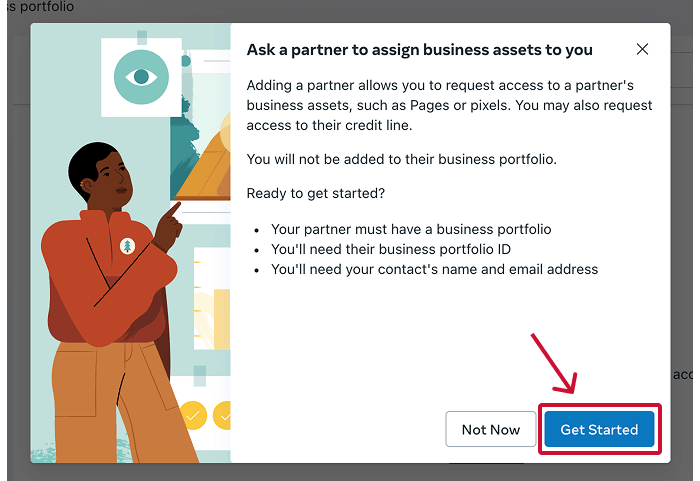
Step 4. A popup will appear. Click ‘Get started’ and follow the prompts to add a contact name, email address, and the Business Portfolio ID of the ad account (not ad account ID!)
Step 5. Under Permissions, click ‘Ad accounts’, and choose the level of access you require. Then click ‘Next’
.png)
Step 6. Review the request and once it’s all good, click ‘Send request’
Step 7. Your client will receive your request and can take one of the following actions:
You'll be notified once your partner responds. You can track your request's status anytime in “Business settings → Partners”, selecting the partner, and checking the status.
💡 If needed, you can cancel your request. Simply go to the “Partners” tab, choose the partner associated with the request, and click “Cancel request.”
Want to learn how to get Facebook Ad account access in a few clicks, without having to know your client's business manager ID? 😎
⚠️ Important: To run ads, you'll also need access to your client's Facebook Page. The ad account and the Facebook Page are separate assets. Without Page access, your ads may not run correctly.
To request Page access: go to Meta Business Suite → Settings → Accounts → Pages → Add → Request Access to a Page, and follow the same process.
Step 1. Go to Ad accounts under Settings in Meta Business Suite at https://business.facebook.com/latest/settings/ad_accounts
Step 2. Click on the ‘+ Add’ button in the top right corner. A popup will appear

Step 3. Select ‘Request to share an ad account’. Doing so does not move the ad account away from its original business portfolio
⚠️ Can’t select this method? Your business portfolio needs to have a primary Page set first, before you can use it to request access to ad accounts and other business assets. Learn how to set a primary Page for your Meta Business Portfolio.
Step 4. Type in your client's Meta/Facebook Ad account ID. They can find it in Meta Ads Manager, it appears as a number in the account dropdown at the top left of the screen. Ask them to share it before you begin. Then, select the level of access you need: Partial access or full control.
🔗 Here's how to find your Meta/Facebook Ad account ID.

Step 5. Choose the access you require (partial or full), then click ‘Confirm’

Step 6. Your request has been sent and an admin of the Ad account has to confirm it. Then, it will show as an asset in your Business Portfolio.
Message to send your client:
Hi [Name], could you please share your Meta/Facebook Ad Account ID with us?
You can find it in Meta Ads Manager, it's the number shown in the account dropdown at the top left.
Once you send it over, we'll send you an official access request through Meta Business Suite. You'll then see it in your Meta Business Settings under Requests → Received, and just need to click Approve.
If you also manage a Facebook Page, we may need access to that separately. We'll send a second request if so.
Thanks!
💡 Pro tip: If your client hasn't approved your request within 24–48 hours, ask them to check Meta Business Settings → Requests → Received, or look for a notification email from Meta.
You can also send them instructions from this article on how to give someone access to your Facebook Ad account.
If your client doesn't have a Meta Business Portfolio, they can add you directly in Ads Manager instead. Here's what they need to do:
Note: This method gives access to one person's Facebook profile, not your whole agency team. If you need team-wide access, ask your client to set up a Meta Business Portfolio first.
Note: The person approving must have Admin or Full Control access to the ad account. If your contact can't find the request, they may not have sufficient permissions. Ask them to check with the account owner. Once you send the request, they will receive an email from Meta.
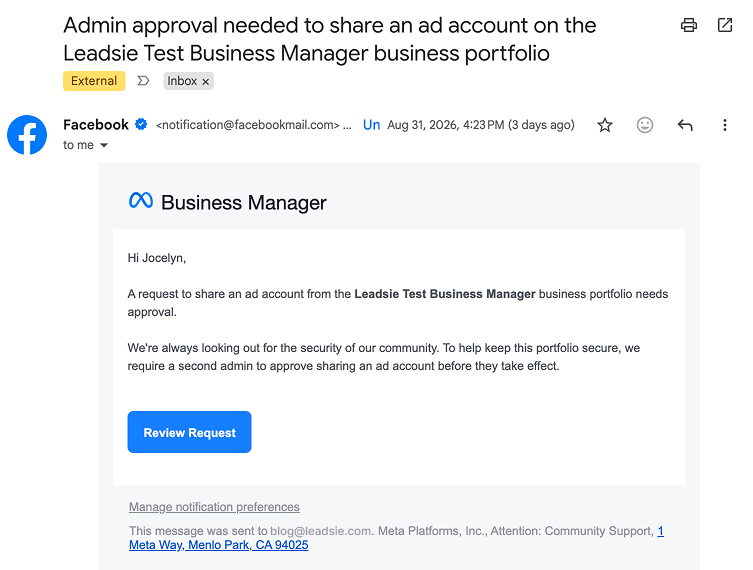
Here’s how your client can approve it (feel free to share these steps with them).
You shouldn’t share passwords or logins with clients: it’s a major security risk for both of you. When you use a client’s personal login, you aren’t just looking at their business page; you’ll have full access to their personal messages, photos, and friends.
Part of the problem is that many agencies still use access methods that were never built for teams. The Agency Growth Pod highlights that “the client should own the ad accounts and the agency should be added to them” gets repeated online so often that it is treated as the default for “transparency purposes”. But in practice, that setup can slow onboarding and make collaboration harder for agencies.
There are also operational downsides:
On top of that, two-factor authentication (2FA), now required for many Meta business actions, makes shared logins even more impractical and unscalable.
You may get stuck in some situations. Here are some common error messages and how to resolve them.
Other similar error messages:
Fix: You don't have sufficient permissions. Ask your client to upgrade your access to Admin/Full Control before retrying, or use our guide to grant ad account access.
🔗 Related article: How to See Who Has Access to Facebook Business Page
Fix: The ad account may be part of a different Business Portfolio, or your own Business Manager may not be fully set up yet. Ask the account owner to add you directly, or complete your Business Portfolio setup before trying again.
Fix: Make sure you're logged in with the same Facebook account the invitation was sent to. Ask the account owner to re-send the invite if it expired or was sent to the wrong email.
Fix: Refresh your Meta Business Suite and check under Accounts → Ad Accounts. If it still doesn't appear, ask your client to check the approval status under Business Settings → Partners.
You need to know who has access to a Business Portfolio to:
🔗 Related: How to create a Meta Business Portfolio and Account
1) Go to Meta Business Suite → 'Settings' → 'Users' → 'People' or go to https://business.facebook.com/latest/settings/business_users/.
2) Go to Meta Business Suite → 'Settings' or go to https://business.facebook.com/latest/settings/.
3) Under 'Users' → select 'Partners'
You'll need to do both steps to see all the people who have access to your Business Portfolio.
💡 Agency pro tip: Alternatively, use our Access Detective feature and let the software do the work for you.
The three methods above are what we consider 'manual' ways of getting access. Time spent on communication, waiting, follow-ups, and action from both parties (it gets tricky for non-tech savvy clients!) can stretch out over days. The manual methods require:
💡 Is your client missing a business portfolio or ad assets? Leadsie can automatically create them in a few clicks. Learn more about how Facebook asset creation works in Leadsie.
Still sending onboarding emails, sharing PDFs, or jumping on calls just to get access to a client's accounts?
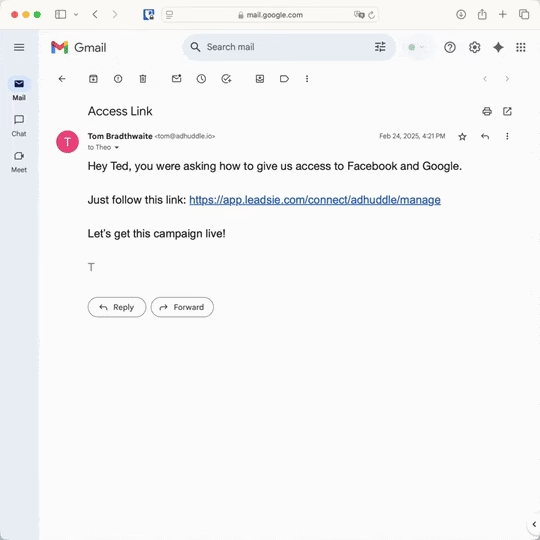
With Leadsie, one secure link handles the entire process. Clients can grant access to Meta, Google, LinkedIn, TikTok, Shopify, and 14+ marketing, advertising, and social media accounts without sharing passwords.
✅ Get access to client accounts in minutes, not days
✅ Replace hours of emails, admin work, and onboarding calls
✅ Scale client onboarding without adding operational overhead
✅ Reduce your agency's turnaround time by over 50%
✅ Start billable work and billing cycles sooner
✅ Create a professional onboarding experience that helps retain clients
✅ Keep access secure with 100% GDPR and CCPA-compliant workflows
💬 "I never want to do onboarding without Leadsie!" - Alyssa, Meta Ads Manager
🎁 Start your free 14-day trial today —no credit card required.
P.S. It's risk-free, and you get to keep your account connections after the trial ends. 🙌

A self-confessed marketing geek with a fetish for spreadsheets, Johannes is in his element when solving problems and building systems for solutions. When he’s not working on Leadsie, you’ll find him sharing his expertise with other startups as a mentor for 500 Global. In his spare time, he enjoys flinging a ball around a tennis court and cycling up daunting-looking mountains.


Clients struggling to share access to their
accounts? Get the access you need in minutes with a free trial of Leadsie.
Approved by Meta, Google & Tiktok
Keep access to accounts if you cancel
Secure & 100% GDPR compliant
Delete your onboarding PDF. Cancel the video call. Just send one link, and get hassle-free access to 13+ platforms in minutes. Start free today.
Approved by Meta, Google & Tiktok
Keep access to clients' accounts if you cancel
Secure & 100% GDPR compliant
Go to adsmanager.facebook.com and log in with your Facebook account. If you don't see an ad account, you may need to create one; this is done automatically when you create a Facebook Business Page. You can also access Ads Manager from your Facebook Page by clicking Ad Center → All Ads.
Check your email or Facebook notifications for an invitation from the account owner. Accept it, then log in to Meta Ads Manager at adsmanager.facebook.com and select the account from the dropdown at the top left. If you can't see the account, make sure you're logged in with the same Facebook account the invite was sent to. Ask the owner to re-send the invite if needed.
The best method is to request Partner access via Meta Business Suite or Leadsie, as it keeps your agency and the client’s assets separate while allowing controlled permissions.
This approach is considered the professional standard because it:
You’ll need:
🔗 Related: How to create a Meta Business Portfolio and Account
To request advertiser access, follow the steps in Method 1 (Partner Access) or Method 2 (Request to Share an Ad Account) above. When you send the request, Facebook will prompt you to choose the level of access you need. Simply select “Advertiser”.
You can’t request access until an Ad Account exists. Send them instructions on how to create a Meta ad account in Meta Ads Manager first.
While clients can add individuals to a personal ad account, this isn’t ideal for agencies. Directly adding a person as a user/admin ties access to one Facebook profile, which means:
Partner access allows structured, secure collaboration, while shared logins create risk.
Meta itself emphasizes assigning roles and permissions instead of sharing access broadly, so each user only has the level of control they need.
It depends on your role:
Meta recommends assigning permissions carefully to maintain security and efficiency.
💡 For most agencies, “Advertiser” is enough unless you also manage billing or users.
Common reasons include:
💡 In many cases, the issue is not technical—it’s client confusion or friction.
No, you must request access to each ad account individually, unless you use Leadsie.
However, once connected, you can manage multiple accounts from one Business Portfolio, making it easier to scale operations.
Questions unanswered? Check out our help center or get in touch 🤠