Clients struggling to share access to their
Microsoft Advertising
accounts? Get the access you need in minutes with a free trial of Leadsie.
14 day unlimited free trial
Extend until you onboard a client
No credit card required
Keep access to clients if you cancel


With easy one-link access requests for 13+ platforms your campaigns can go live in minutes, not days. Start free today.
Approved by Meta, Google & Tiktok
Keep access to clients' accounts if you cancel
Secure & 100% GDPR compliant


Microsoft Ads might not get as much attention as Google, but it’s becoming an increasingly valuable channel, especially for B2B advertisers looking to reach a more desktop-heavy, professional audience and potentially lower their CPC.
But once you decide to run Microsoft Ads, there’s one problem most teams run into almost immediately:
Getting access to the account.
Between confusing user roles, hidden menus, account IDs, and back-and-forth with clients, what should be a quick setup can easily turn into a frustrating process.
Whether you’re:
This guide will walk you through exactly how to give and request access to Microsoft Ads without the confusion. 👇
If you just want the quick version:
There are four main roles you can assign to someone in your Microsoft Advertising account.
Here’s a summary:
The person who created the Microsoft Ads account is automatically given the Super Admin role and full permissions for all accounts.
Best for: Business owners, internal marketing leads, or anyone responsible for billing and account ownership.
⚠️ Security tip: Always have at least two Super Admins. If the only one leaves or loses login access, no one else can manage the account (and recovering access through Microsoft support is a slow, painful process).
The Standard User role is designed for people who actively manage campaigns but don’t need full account control.
✅ They can:
❌ But they can’t:
Best for: Marketing agencies managing ads, PPC specialists, and internal team members running campaigns.
This role is purpose-built for people whose job is to run campaigns and nothing else.
✅ They can:
❌ But they can’t:
Best for: Junior marketers, external partners who only need to manage ads (not settings), and short-term hires.
The Viewer role provides read-only access to the account.
✅ They can:
❌ But they can’t make any changes.
Best for: Stakeholders who need visibility without involvement.
Most Microsoft Ads accounts support up to 15 users per account.
If you’re an agency, this usually isn’t something you need to worry about.
That’s because you’re not expected to add your entire team directly into a client’s account. Instead, you’ll link your account to each client’s account (more on that below) and manage everything from your own login.
Since each client account has its own user limit, you can work across multiple clients without running into a single global cap.

If you want to give someone access to your Microsoft Ads account, you’ll need to invite them as a user and assign the right role.
📝 Before you start, make sure:
Once that’s sorted, follow these steps to invite a user:
Step 1. Go to Microsoft Advertising and log in with your account.
Step 2. Hover over “Settings” in the left menu and select “User management.”

This is where all user access is controlled.
❗ If you don’t see this option, it usually means:
Step 3. Click “Invite user.”

Step 4. Enter their information, select a user role, and specify the account(s) they can access, then click “Send.”

💡 Good to know: The email you enter is just for sending the invite. The user can log in with a different Microsoft account after accepting it.
Step 5. Ask them to check their inbox and accept the invitation. They'll be guided to log in or set up an account to join your team.

You can update someone’s role or remove their access from the same place in Microsoft Ads.
✏️ Before making changes, keep in mind:
From there, you can update or remove access in just a few steps:
1. Go to Settings > User management.
From here, what you do depends on your goal:
If you’ve invited someone to your Microsoft Ads account, they’ll need to accept the invitation before they can access it.
Send them the steps below to speed up the process and avoid back-and-forth:
Step 1. Look for an email from Microsoft Advertising with the subject line: “Invitation to Microsoft Advertising.”
If you don’t see it, check your spam/junk folder or ask the account owner to resend the invite.
Step 2. Open the email and click the invitation link to begin setting up your access.
⚠️ Important: You have 30 days to accept the invitation before it expires.
Step 3. Choose how you want to sign in.
You’ll see two options here:

Use whichever account you want tied to your access. It doesn’t have to match the email the invite was sent to.
Step 4. Confirm your contact details and accept Microsoft Advertising’s terms.
Then click “Save” to continue.
Step 5. Once setup is complete, you’ll be taken into Microsoft Ads and should now see the account you were invited to. 🎉
If you’re an agency working with a client, you don’t have to be added as a regular user. Instead, you can link your account to theirs and manage everything from your own login.
Rather than placing everyone in a single account, Microsoft lets you keep accounts separate and allows access through linking. This means:
✔️ Clients keep full ownership of their account (even if they switch agencies)
✔️ Agencies can manage multiple clients without sharing logins
✔️ Billing and permissions can be kept separate
📝 Before you start, you’ll need either your client’s:
💡 Not sure where to find these? Share this guide with your client: how to find your Microsoft Advertising account numbers.
Step 1. In your Microsoft Ads dashboard, open the left-hand menu and click “Tools.”
Step 2. Scroll to the Account & billing management section and select “All accounts.”
.png)
Step 3. Go to “Account summary” and look for the Requests tab.
.png)
This is where you can send and manage linking requests.
Step 4. Click “Link to accounts.”
.png)
Step 5. Enter your client’s account number.

⚠️ Make sure you’re using the correct type:
These are different from the Manager account ID, which is only used by Microsoft support.
💡Tip: If your client don’t know where to find their number, it’s usually visible in the account dropdown at the top or under Settings > Account settings.

Step 6. It’s time to set your access details. You’ll be asked to:
⚠️ Be aware that If you take over billing, you'll also be responsible for any pending charges on the account once your request is accepted. You can choose to take over billing at any point.
Step 7. Send the request to your client.
Once submitted, they will receive a notification, and they’ll need to approve the request before you get access.
⏳ If they don’t accept within 30 days, the request will expire and need to be resent.
🔗 Related: Agency client onboarding best practices
If your client struggles to find the linking request, send them the steps below:
Both the account owner (client) and the agency (direct manager) can unlink accounts at any time.
This is useful if you’re ending a contract, switching to a new agency, or bringing campaign management in-house.
💡Tip: It’s also a good idea to download reports or confirm handover details like billing before removing access.
🔗 Related: 7 Client Retention Strategies for Agencies
Manually requesting access to client accounts often means you have to:
❌ Ask the client for their account number (which they probably don’t know where to find).
❌ Walk them through hidden menus.
❌ Wait for them to accept the request in the right place.
❌ Follow up when something inevitably gets missed.
And if you’re doing this across Google, Meta, and Microsoft Ads, that back-and-forth can quickly add up.
But there’s a simpler way.
Leadsie is a client onboarding tool that lets agencies request Microsoft Ads access by sending a single secure access link to clients. Instead of asking for account IDs or walking them through setup, all they have to do is log in, select the account they want to share, and confirm access.
Here's how it works:
Step 1. Set up a new (or custom) access request link in your Leadsie dashboard and select Microsoft Ads (along with any other platforms you need access to).
Leadsie supports 30+ platforms, so you can request everything at once.
Step 2. Share your Leadsie link with your client via email, Slack, or wherever you communicate.
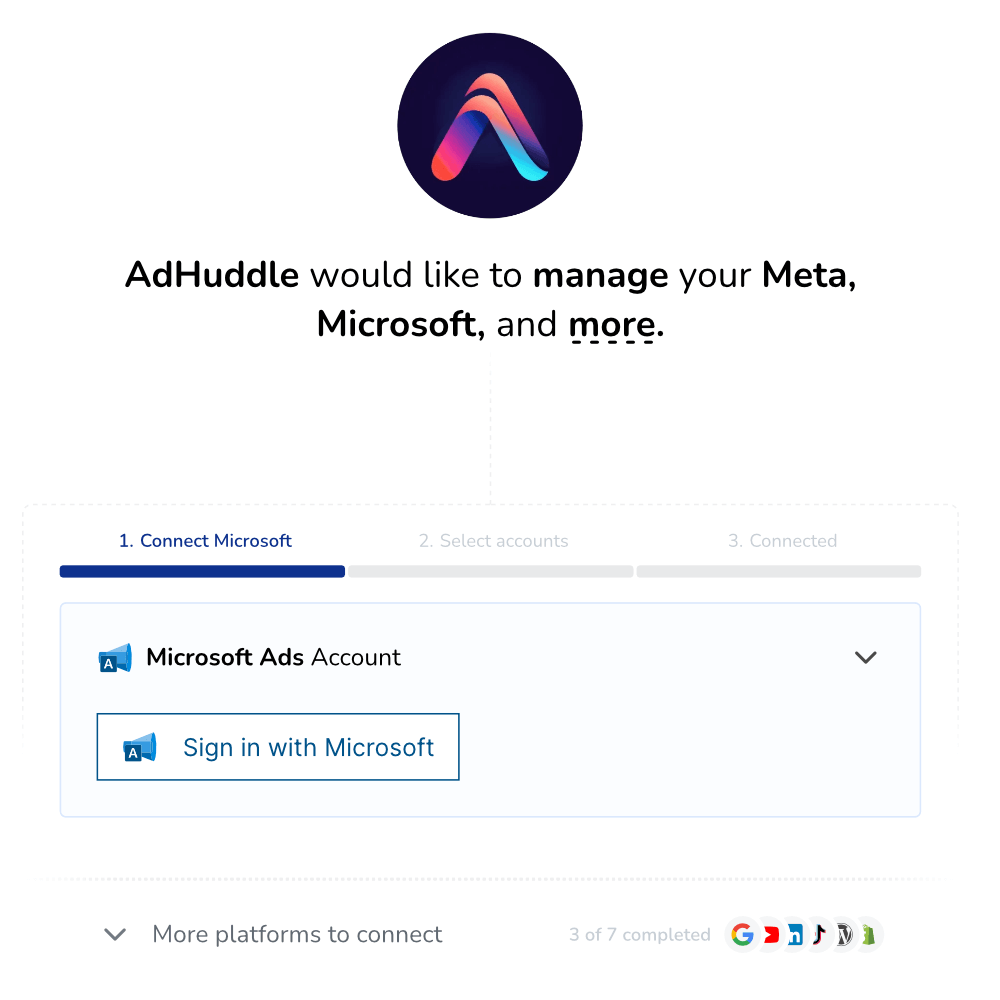
Step 3. Your client logs in with their Microsoft account, selects the ad account they want to share, and confirms access.

That’s it. Once they’ve confirmed, the account is linked, and you can start managing their campaigns straight away! 🎉

🔗 Related: Best Ways Agencies Can Automate Client Onboarding
Even if you follow all the steps correctly, it’s pretty common to run into issues when accessing a Microsoft Ads account.
Here’s what to look out for:
This usually happens when the email you’re trying to use isn’t actually set up as a Microsoft account.
How to fix:
This sounds simple, but it often happens when users have multiple Microsoft accounts (work + personal).
It’s also common when using the same email across different Microsoft services.
How to fix:
This is usually caused by too many failed attempts or browser/session issues.
How to fix:
This is one of the most common issues. Usually, it means you haven’t accepted the invite yet, or you signed in with the wrong account.
How to fix:
Microsoft Ads behaves differently depending on whether you’re using a personal account (e.g., Gmail, Outlook) or a work account (managed by your company).
Some organisations require one or the other.
How to fix:
If you’re stuck at the verification step, it’s often due to device issues or not completing the prompt properly.
How to fix:
This is less common but more serious. It usually means Microsoft has flagged the account for policy or security reasons.
How to fix:
Are you an agency that needs access to multiple marketing or social media accounts?
With Leadsie, you can request and receive access to all your clients’ accounts in just a few clicks.
Leadsie is a client onboarding software that simplifies requesting and giving access to marketing assets, social media, and ad accounts with one secure link. Get access to your clients' X, Facebook, Instagram, Google, TikTok, Shopify, LinkedIn, and other platform accounts without sharing passwords. 🔒

Leadsie automates account access management to deliver a fast, secure, and seamless client onboarding experience, helping you impress clients and showcase professionalism from day one.
✅ Minimize frustrating chaser emails and calls for access
✅ Reduces your agency's turnaround time by over 50%
✅ Scales with your agency as you grow beyond onboarding 5-10 new clients a week
✅ Makes it possible to get access to 31+ social, marketing, and analytics platforms at once
✅ Start billable work and billing cycles for your new clients without delays
🎁 Try a free 14-day trial on us—no credit card needed!
P.S. It's risk-free, and you get to keep your account connections after the trial ends. 🙌
💬 "I never want to do onboarding without Leadsie!" - Alyssa, Meta Ads Manager
🎁 Start your free 14-day trial today —no credit card required.
P.S. It's risk-free, and you get to keep your account connections after the trial ends. 🙌

Dov is a freelance writer who prides himself on offering insightful content that will engage your audience and solve their problems. In his free time, he's often found wandering through the Himalayas, sometimes with a hiking pole, but almost definitely with a book.


Clients struggling to share access to their
Microsoft Advertising
accounts? Get the access you need in minutes with a free trial of Leadsie.
Approved by Meta, Google & Tiktok
Keep access to accounts if you cancel
Secure & 100% GDPR compliant
Delete your onboarding PDF. Cancel the video call. Just send one link, and get hassle-free access to 13+ platforms in minutes. Start free today.
Approved by Meta, Google & Tiktok
Keep access to clients' accounts if you cancel
Secure & 100% GDPR compliant
No, you don’t need to add agencies as users. The recommended approach is to link accounts instead, which allows the agency to manage your campaigns without taking ownership of your account.
Adding a user gives someone access inside your account with a specific role (e.g., Standard User or Viewer).
Linking accounts is used for external access (like agencies) and allows them to manage your account from their own dashboard without being added as a user.
No. Microsoft Ads allows you to access multiple accounts from one login.
Once accounts are linked or access is granted, you can switch between them without logging in and out.
The fastest way is to use a tool like Leadsie, which lets clients grant access via a single secure link, without needing account IDs or navigating the Microsoft interface.
Questions unanswered? Check out our help center or get in touch 🤠